
Salt water pool startup
The company that made your cell picks the salt level, anywhere between 3000 and 4000 ppm (parts per million, the number a salt test shows). Outdoors, stabilizer sits at 30 to 50 ppm with an AquaRite 900, while older AquaRite equipment calls for 60 to 80 ppm. Put in the stabilizer along with the salt. After that, leave the pump going for 24 hours ahead of switching on the cell. Bags of coarse solar salt weigh 40 to 80 lb.
What to add first?
Dissolve the salt fully ahead of switching the cell on.
Cyanuric acid stabilizer goes on your list as well. Per Hayward's AquaRite 900 manual, outdoor pools take 30 to 50 ppm of it, and indoor pools take 0 ppm. Manuals for older AquaRite units put the goal at 60 to 80 ppm, and Intex says around 1% of your salt's weight works.
Tip in the coarse solar salt, which comes in 40 to 80 lb bags. Let the pump circulate a full 24 hours so the salt has dissolved before the cell gets switched on.
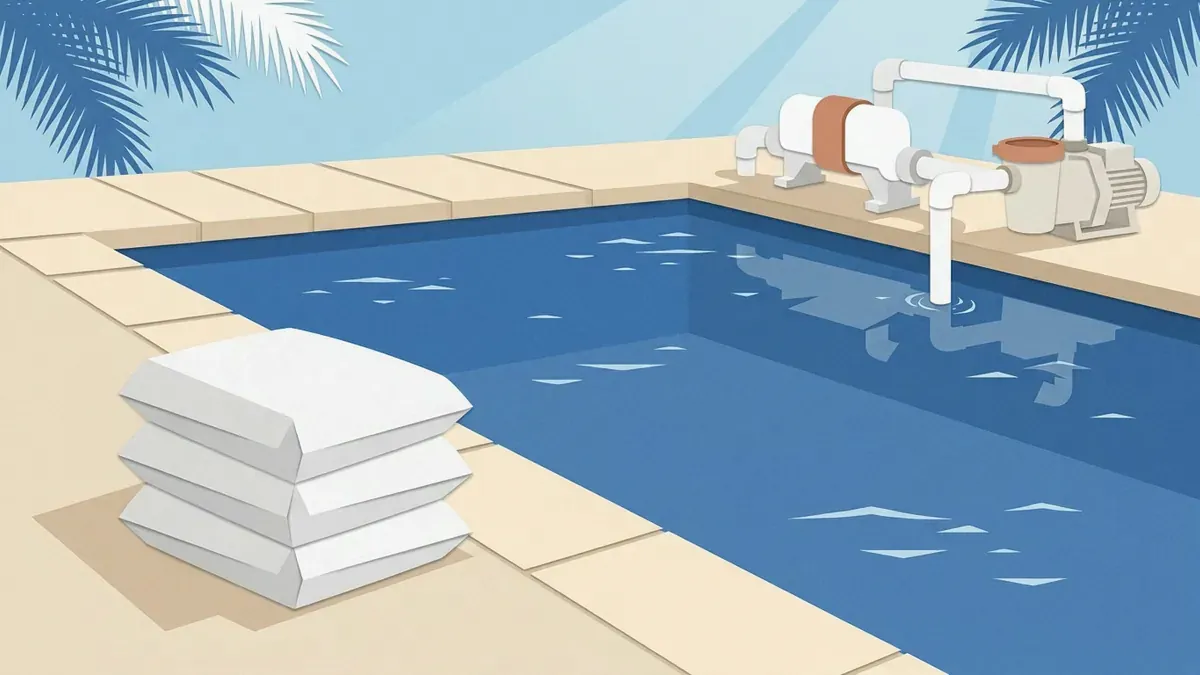
Adding salt: what comes before
Salt can't go straight onto a freshly finished pool surface. New plaster means holding off 10 to 14 days before the salt goes in, according to Hayward's manual. With a new or refinished pool, Jandy's TruClear manual has you waiting a minimum of 30 days.
Which salt level to hit depends on the brand of your cell. A Hayward AquaRite operates at 2700 to 3400 ppm, with 3200 ppm being ideal. Per Pentair's IntelliChlor guide, 3600 ppm is the recommendation, identical across Plus and LT models.
A 3000 ppm target is shared by Jandy TruClear, Intex Krystal Clear and Bestway Flowclear. The Jandy AquaPure calls for 3.0 to 3.5 gpl (grams per liter; 1 gpl is 1,000 ppm). In ppm, that works out to 3000 to 3500. A CircuPool is happiest at 3500 ppm yet operates well anywhere from 3000 to 4000 ppm. With CircuPool SJ models, the target is 4000 ppm.
Switching on the cell
Never hit the chlorinator switch while salt still lies on the pool floor. Give it time to dissolve beforehand.
Per Hayward, the filter pump should go for 24 hours, drawing through the main drain. Per Pentair, the pump runs a minimum of 24 hours following each time salt goes in. For the Intex Krystal Clear, Intex's manual wants circulation running 24 hours straight.
Starting a salt pool up in spring
Come spring, check what salt level your cell needs ahead of buying anything.
Each gallon of water comes in at 8.34 pounds. For an AquaRite 900, raise stabilizer to 30 to 50 ppm, pour the salt in and let it run for 24 hours.
Questions people bring to the counter
What's the process for starting a saltwater pool the first time?
New plaster under Hayward means a 10 to 14 day wait, while a new surface with Jandy TruClear means 30 days. Stabilizer goes in, plus coarse solar salt sold in 40 to 80 lb bags, until your system reaches its target ppm. Let the filter pump go 24 hours so the salt dissolves before the unit comes on.
Which chemicals do I need to get my salt water pool going?
Cyanuric acid stabilizer goes on your shopping list, and so does coarse solar salt. An outdoor Hayward AquaRite 900 needs 30 to 50 ppm of stabilizer, and older AquaRite models call for 60 to 80 ppm. Add salt as well, aiming for 3000 ppm with Intex, 3200 ppm with Hayward or 3600 ppm with Pentair.
Does a salt water pool still call for chemicals?
Yes. Both Hayward and Intex give a stabilizer figure right alongside the salt figure. With a 3000 ppm salt goal, Intex suggests holding stabilizer near 1% of the salt weight. A Hayward AquaRite 900 outdoors runs on 30 to 50 ppm of stabilizer, and indoor pools stay at 0 ppm.
What goes into a saltwater pool to get it running?
Stabilizer and coarse solar salt, bagged at 40 to 80 lb, are what you'll pour in. Match your equipment: 3000 ppm with Bestway, 3500 ppm with CircuPool or 3600 ppm with Pentair. Once the salt is in, keep the pump going for 24 hours before the cell comes on.